Bay windows are the room’s centrepiece and the house’s most complicated blind job: multiple blinds meeting at angles, in the window everyone sees from the street. It’s absolutely DIY-able — but it’s the job where planning beats enthusiasm, and the honest answer for some bays is a professional.
The basic geometry
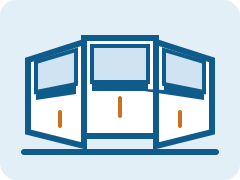
A bay is a set of flat window facets meeting at angles — commonly three facets (a “splayed” bay, often at 120°-ish angles), sometimes five, or a squared-off “box” bay at 90°. Blinds being straight, the standard approach is one blind per facet, fitted inside the bay’s recess space, meeting as neatly as the corners allow.
The two things that make or break the result:
- Corner clearance. At each internal corner, two blinds approach each other at an angle. Their brackets, cassettes and slats need physical room to coexist — and tilted venetian slats or a stacked roman need more room than a flat roller. This is why bay planning starts at the corners, not the middles.
- Headrail alignment. All the blinds must sit at exactly the same height, or the bay looks visibly wrong. Decide one datum height and mark it right around the bay with a level (laser levels earn their keep here).
Measuring a bay
Read the general measuring rules first — everything there applies, facet by facet. Then:
- Measure each facet as its own window: three widths, three drops, smallest of each. Facets in the same bay are frequently not the same size, even when they look identical.
- Mock up the corners. Cardboard cut to the blind’s projected depth (cassette + fabric, or slat width for venetians) held into the corner shows immediately whether two blinds can meet without fouling. Do this before ordering, not after.
- Decide gaps deliberately. A small even gap at each corner looks intentional; blinds jammed hard into corners rarely close properly. Several online retailers publish bay-specific deduction advice per product — as ever, the retailer’s product instructions are the ones that bind.
- Note your handles. Bay facets often have protruding handles right where a corner blind wants to hang. Shallow-profile blinds or frame-mounted (Perfect Fit-style) systems dodge this on uPVC bays.
Fitting
Fitting each facet is the standard job from the fitting walkthrough — same lintel detective work, same fixings logic. The bay-specific discipline is sequence and datum: fix all brackets to the single marked height line, dry-fit all headrails before final tightening, and start from the centre facet so the corner clearances split evenly.
Budget real time. A three-facet bay is not three times a normal window — it’s more, because of the corner offering-up and alignment checks.
When to hand a bay to a professional
Be honest about these triggers:
- Facets that are clearly different sizes or visibly out of square
- Five-facet Victorian bays, curved bays, or continuous curved vertical tracks (specialist kit, genuinely not DIY)
- Expensive products — shutters, interlined romans — where a corner planning error costs serious money
- Any bay where the cardboard mock-up left you unsure
A measure-and-fit service absorbs exactly this category of risk, and bays are the job they’re best at. Ask the corner question directly when comparing quotes — the fitter questions guide shows what a fluent answer sounds like. Costs sit at the premium end of the ranges in the cost guide, and for this window, that’s usually money well spent.
Frequently asked questions
Do I need one blind or several for a bay window?
Almost always one blind per facet of the bay — three facets, three blinds. Blinds are straight objects; the 'one curved blind' options are limited to specialist curved tracks for verticals and a few bendable systems, which are measure-and-fit territory.
What's the hardest part of a bay window blind job?
The corners. Adjacent blinds compete for space where facets meet at an angle, so you must plan bracket positions and clearances before ordering — and the three headrails need to sit at exactly the same height, or the mismatch is visible from the street and the sofa.
Which blind types work best in bays?
Individually-fitted rollers, romans, venetians and day-and-night blinds all work facet by facet. Vertical blinds on a continuous curved track suit wide shallow bays. Shutters are the premium option. Deep sills also make bays one of the few places Perfect Fit-style frame-mounted blinds shine on uPVC.