Every blind ordered online is cut to the numbers you type in, and made-to-measure goods generally can’t be returned because you measured wrong. So this page is deliberately pedantic. Ten careful minutes with a metal tape is the difference between a blind that looks built-in and an expensive strip of fabric that fits nowhere.
The two ways to fit a blind
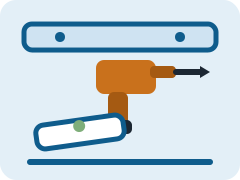
Recess fit (inside the window opening). Neat, keeps sills usable, shows off the window. But any blind in a recess has small light gaps at the edges, and the recess must be deep enough for the blind’s mechanism.
Exact/outside fit (on the wall, covering the opening). Blocks more light, hides out-of-square openings, works when the recess is too shallow. The blind sits proud of the wall and the sill is covered when it’s down.
Decide this first — it changes what you measure and what the retailer does with your numbers.
Rules that apply to every measurement
- Use a metal tape measure. Fabric tapes stretch and flex.
- Record millimetres, and write each number down as you go.
- Measure every window separately, even in a row of “identical” windows — they rarely are.
- Label the numbers (“kitchen left, width, recess”) — a week later, unlabelled numbers are worthless.
- Width is always quoted first, then drop. Transposing them is a classic irreversible mistake.
Measuring for a recess fit
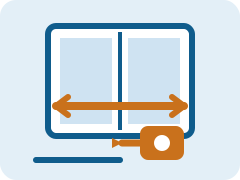
- Width: measure the recess at the top, middle and bottom. Record the smallest.
- Drop: measure at the left, centre and right. For most blinds use the smallest so the blind clears the sill.
- Depth: measure from the glass (or the nearest obstruction — handles count) to the front face of the wall. Compare with the minimum depth on the product page of the blind you’re buying; that figure varies by blind type and brand.
- Submit the numbers as recess size — the maker applies their own deductions so the blind runs freely. Don’t deduct anything yourself unless the retailer’s instructions explicitly tell you to; a double-deducted blind arrives narrow with wide light gaps.
Measuring for an exact/outside fit
- Decide coverage: overlap of roughly 50–75 mm per side is a common starting point (more for bedroom light control), plus enough height above the opening for the brackets to fix into solid wall.
- Measure the total finished width and drop you want the blind to be, and submit them as exact/blind size — the maker cuts to those numbers with no further deduction.
- Check what the blind will hit: handles, taps, radiator pipes, a protruding sill. Hold a stiff tape or a batten where the blind will hang and look from the side.
The one rule that overrides this page: every retailer publishes its own measuring instructions, and some differ on deductions, especially for romans and verticals. Read the instructions for the specific product before ordering. Where they conflict with anything here, the retailer’s rules win — they’re the ones cutting the fabric.
Type-specific quirks
Each blind type has its own wrinkles — stack sizes, slat projections, cassette depths. They’re covered in the individual guides: roller, venetian, vertical, roman and day & night. Bay windows are their own discipline: see blinds for bay windows.
If you’d rather not carry the risk
Measuring isn’t hard, but the consequences of getting it wrong are non-refundable. If your windows are awkward — bays, out-of-square Victorian openings, very wide spans — a measure-and-fit service moves that risk onto a professional, and the cost guide shows what that insurance costs.
Frequently asked questions
Do I measure in millimetres or centimetres?
Measure in millimetres. Retail order forms accept mm or cm, but measuring in mm removes rounding ambiguity — a blind maker cuts to the millimetre, and 'about 1.2 m' is how wrong blinds get ordered.
What if my recess isn't square?
Almost none are, which is why you measure width and drop in three places. For a recess fit use the smallest width so the blind doesn't jam. If measurements differ by more than about 10 mm, consider fitting outside the recess where the wonkiness won't show.
Who is responsible if a made-to-measure blind doesn't fit?
If it was made to the sizes you submitted, you are — made-to-measure goods are exempt from standard change-of-mind returns. If the blind doesn't match the sizes you gave, the retailer must remedy it. This asymmetry is the whole argument for measuring carefully, and it's why measure-and-fit services carry the risk instead.