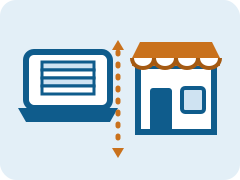
Once you’ve decided against full DIY-from-a-superstore and against a national in-home sales visit, the real contest for most people is: order made-to-measure from an online specialist, or walk into the local blind shop? Both sell you a blind cut to your window. They differ in who does the work, who carries the risk, and how much of your money goes where.
The price gap, honestly
Online made-to-measure is consistently cheaper for like-for-like products — often dramatically so during the near-permanent sales cycles online retailers run. That’s not because local shops are greedy: a shop pays rent, staff, a van and a fitter, and its price usually includes measuring and fitting service or offers it cheaply. You’re choosing between two legitimate cost structures, not spotting a bargain.
The honest framing: the online discount is your wage for measuring and fitting, plus your premium for insuring the measurement yourself.
What online does well
- Price and range. National-scale manufacturing, huge fabric ranges, frequent discounts.
- Free samples. Every serious online retailer posts fabric samples free — use them, screens lie about colour.
- Convenience. Measure on Sunday (carefully), order in ten minutes, blinds arrive within a week or three.
- Guides and tools. The big retailers’ measuring instructions are genuinely good, product by product — and they’re binding: follow the instructions of the shop you’re buying from.
The catch is singular but sharp: your numbers, your problem. A mis-measured custom blind is usually yours to keep (check each retailer’s remake goodwill policy — some are more generous than the law requires).
What the local shop does well
- Someone measures who does it daily — and owns the result.
- Awkward windows. Bays, out-of-square period openings, unusual shapes: a professional eye on-site beats any online form (bay windows are the classic case).
- Touch and see at scale. Big sample books, mechanisms to operate, advice shaped by your actual house.
- A relationship. Snags get fixed by the person who sold to you; reputations are local and precious.
You pay for all of this in the blind price, and selection may be narrower than the national online ranges.
A decision rule that mostly works
- Standard rectangular windows + confidence with a tape and drill → online. The saving across a house is substantial, and the fitting itself is beginner-level for rollers and most light blinds.
- Bays, period wonkiness, expensive fabrics, motorisation, or zero appetite for ladders → local shop or measure-and-fit service. The premium is insurance plus labour, fairly priced — the cost guide shows the gap you’re paying.
- In between → hybrid. Order online, pay a fitter or handyperson to install. You still carry measuring risk, so reserve this for straightforward openings — and vet the fitter with the twelve questions.
If you go online
Order samples first; measure in millimetres with a metal tape; follow the retailer’s own product-specific instructions over any general advice (ours included); and double-check width-before-drop on every line of the order. The retailers below are established UK made-to-measure specialists we consider reasonable starting points.
Frequently asked questions
Why are online made-to-measure blinds cheaper?
Online retailers don't run showrooms, home visits or fitting teams, and they manufacture at national scale. You do the measuring and fitting — the two labour-heavy steps — yourself, and you carry the measurement risk. The discount is payment for that work and risk.
Can I return a made-to-measure blind if I measured wrong?
Generally no — custom-made goods are exempt from the usual online change-of-mind rules. Some online retailers soften this with goodwill remake schemes within limits; read the specific policy before ordering. If the blind doesn't match the sizes you submitted, that's a fault, and the retailer must remedy it.
Are online blind samples worth ordering?
Always, and they're usually free. Fabric colours on screens are unreliable, and light in your room changes everything. Ordering three or four samples costs nothing but a few days and prevents the most common non-measuring regret: the colour being wrong.