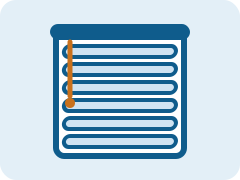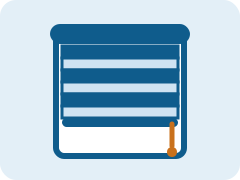
Day and night blinds — also sold as zebra, vision or duo-roller blinds — are roller blinds with two layers of striped fabric. Slide the layers so the sheer bands line up and you get filtered daylight and privacy; slide them so solid covers sheer and the blind behaves like a normal roller. They’ve become the fashionable middle ground between a roller and a venetian.
What they’re actually good at
- Daytime privacy with light. The classic use: street-facing living rooms and home offices where you want daylight but not eye contact with the pavement.
- Adjustability without slats. You get most of a venetian’s flexibility with none of the dusting — the layers are smooth fabric.
- A modern look. The wide fabric bands read as contemporary in a way vertical louvres and aluminium slats often don’t.
And their limits: they don’t do true blackout, the double layer makes them bulkier on the tube than a plain roller (mind shallow recesses), and per square metre they cost more than a basic roller — usually between roller and roman territory.
Measuring
Measuring is identical to a roller blind: smallest of three widths and drops for a recess fit, finished sizes with overlap for an outside fit — the full method is in the measuring guide.
Two extra checks:
- Cassette depth. Most day and night blinds come in a cassette (an enclosed headrail) that keeps the two fabric layers aligned. Cassettes need more recess depth than open-tube rollers — check the product’s stated minimum against your recess, remembering window handles.
- Light gaps. As with any recess-fitted roller there will be side gaps. Because people often buy these blinds for privacy, think about whether an outside fit with overlap serves you better.
Fitting
Fitting is the same two-or-three-bracket job as a roller, with the same rules about lintels, level and plugs — the fitting walkthrough applies unchanged. The cassette makes the blind slightly heavier and less forgiving of off-level brackets: if the cassette isn’t level, the fabric tracks sideways on the tube and the stripes slowly walk out of alignment.
After fitting, run the blind fully down and back up once or twice and fine-tune the layer alignment with small chain movements. Fix the chain tensioner to the wall — the safety rules for corded blinds apply (child-safe blinds).
Should you pay for fitting?
A single day and night blind on an ordinary window is comfortably DIY. Where we’d consider a professional: multiple blinds across a bay (the cassettes need to line up visually — see blinds for bay windows), or tiled and concrete-heavy walls. Costs and the wider decision are covered in DIY vs professional fitting and the fitting cost guide.
Frequently asked questions
Are day and night blinds any good for bedrooms?
For evening privacy with soft light they're excellent. For proper darkness they're mediocre: even aligned closed, the woven bands let a glow through. Choose a blackout roller or lined roman for a sleeper who needs a dark room.
Why is my day and night blind hard to align?
The stripes align only when the fabric loop is positioned precisely — a chain tick too far and bands half-overlap. Cheaper mechanisms drift with temperature and use. It's normal to nudge the chain a little; a blind that won't hold alignment at all is usually a warranty issue.
Can day and night blinds go in bathrooms?
Many are polyester and cope with an averagely ventilated bathroom, but the double fabric layer dries slowly, so heavy condensation can mark it. A faux wood venetian or plain moisture-resistant roller is the safer pick for steamy rooms.